
Vale, a Brazilian-based global mining company, has concluded an agreement with China’s Shandong Shipping Corporation to develop the world’s first ethanol-powered ocean-going bulk carriers, aiming to reduce carbon emissions by up to 90% compared to conventional heavy fuel oil.
First ship should start operating at Vale’s service from 2029.
The agreement marks a major maritime decarbonisation milestone for global iron ore transport: this is the first time in the maritime industry that ethanol will be used as the primary fuel on an ocean-going vessel.
The initiative supports Vale’s commitment to reduce Scope 3 emissions by 15% by 2035, accelerating maritime decarbonization in line with International Maritime Organization (IMO) targets
The agreement between Vale and Shandong includes a 25-year contract for the construction of two vessels, with an option for additional ships.
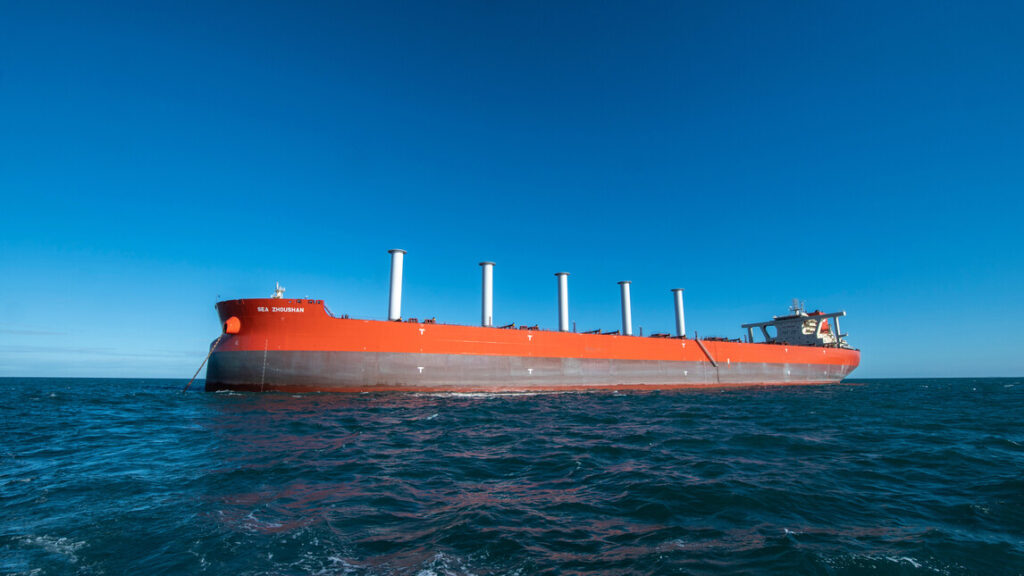
Two 325,000-tonne “Guaibamax” vessels measuring 340 meters in length are expected to start operating in 2029, featuring triple-fuel engines (ethanol, methanol, bunkering) and rotor sails for added efficiency. The design allows for future conversion to liquefied natural gas (LNG) or ammonia.
Vale’s director of shipping Rodrigo Bermelho said Vale’s pioneering efforts towards decarbonization in maritime transport focuses on blending efficiency with operational flexibility.
‘The use of ethanol as fuel in the ships that transport our ore, combined with the adoption of rotor sails to harness wind energy, places Vale in a unique position for the energy transition in global shipping over the coming decades, whilst driving similar initiatives in the sector,’ he said.
Second-generation ethanol can reduce carbon emissions by approximately 90% compared to heavy fuel oil on a well-to-wake basis.
Beyond shipping, the company’s adoption of ethanol in its logistics operations includes trials on trucks and on locomotives on the Vitória a Minas Railway (EFVM) locomotives.
The new ethanol-powered ships will be similar to 10 other dual-fuel vessels (methanol and heavy fuel oil) that Shandong will deliver to Vale from 2027 onwards.
These vessels will be equipped with five rotor sails for wind-assisted propulsion.
As part of Vale’s Ecoshipping program, these technologies and alternative fuels are being tested and implemented to decarbonize its maritime transport of iron ore, with a goal to reduce GHG emissions by approximately 15% compared to current Guaibamax vessels.
Vale’s chartered fleet includes the first-generation Valemax vessels since 2011, second-generation Valemax (2018) and first generation Guaibamax (2019). These vessels can reduce CO2 equivalent emissions by up to 41% compared to a standard capesize vessel.
Since 2020, Vale has invested around US$1.4 billion in initiatives to reduce its Scope 1, 2 and 3 emissions. The company has committed to a 15% reduction in Scope 3 emissions by 2035 along its value chain, as part of its climate strategy.