
Nestle Malaysia and Universiti Putra Malaysia (UPM) have partnered to scale up the HalSTEM programme, expanding halal-focused Science, Technology, Engineering, and Mathematics (STEM) education for secondary students.
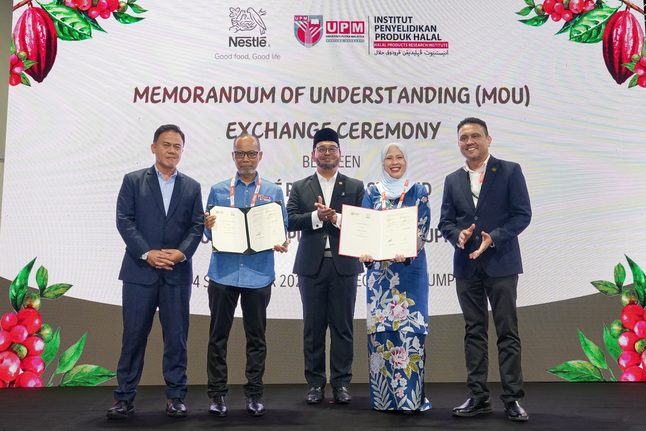
The collaboration was formalised through a memorandum of understanding (MoU) exchanged between Nestle Malaysia and UPM’s Halal Products Research Institute at the Malaysia International Halal Showcase (Mihas) 2026 at Mitec in Kuala Lumpur.
The partnership aims to expand halal in STEM education through the HalSTEM programme, equipping more Malaysian secondary school students with practical insights into the science, technology and innovation underpinning the halal industry.
Under the collaboration, both parties will jointly develop, enhance and implement HalSTEM modules, educator training and student outreach activities.
The partnership is also part of Nestle Malaysia’s Synergy Halal collaboration with the Department of Islamic Development Malaysia (Jakim), a holistic initiative to nurture a complete halal ecosystem encompassing consumer awareness, talent development, SME empowerment and the advancement of halal logistics and supply chain partners.
This holistic ecosystem approach helps secure Malaysia’s position as a world-class leader and premier hub in the global halal market.
Nestle Malaysia head of halal affairs Nasrul Hadi Mohamed Nor said the company views halal compliance as the fundamental base for its operations and consumer trust, driven by rigorous assurance standards and leadership as a global Halal Centre of Excellence.
“Through HalSTEM, we want to help young Malaysians see how science, technology and innovation support halal assurance and quality.
“By combining classroom learning and real industry exposure, we hope to spark greater interest in STEM and inspire the next generation of talent for the halal sector,” he said.
Students in the HalSTEM programme will take part in hands-on activities that demonstrate how STEM concepts are applied in halal assurance and the food industry.
These include the use of microscopy-based halal authentication, comparisons of plant and animal-derived ingredients, artificial intelligence tools, water filtration, sertu soap-making and nutritional calculations.
Meanwhile, UPM deputy vice-chancellor (industry and community network) Shamsul Bahri Md Tamrin said UPM would contribute academic rigour, module development and research expertise through its Halal Products Research Institute, while Nestle Malaysia would contribute practical industry insights, quality standards and real-world exposure.
“Together, we can create learning experiences that are both scientifically grounded and relevant to the realities of the halal sector.
“We also see strong potential for knowledge exchange and research collaboration in halal science and technology,” he said.
The collaboration aligns academia with industry to support national priorities. It enhances STEM skills and halal awareness among Malaysian youth, securing a future-ready talent pipeline.